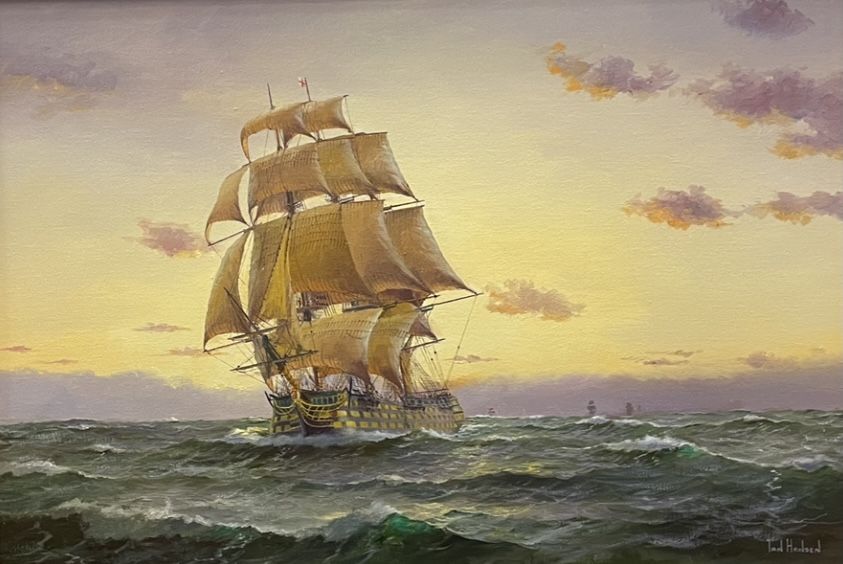
H. M. S. Victory Oil on Stretched Belgian Linen 66cm x 46cm
Lord Nelson’s flag–ship at the “Battle of Trafalgar 1805”. First rate ship of the line 104 guns launched May 1765 at Chatham. “Victory” is still in commission at Portsmouth Naval Dockyard. Launched on 7 May 1765 at Chatham Dockyard, Kent, HMS Victory was one of the most celebrated warships in British naval history. Designed by Sir Thomas Slade, Surveyor of the Royal Navy, she was built as a first-rate ship of the line, originally armed with 100 guns. Following a major reconstruction between 1800 and 1803, her armament was increased to 104 guns. A magnificent three-decked sailing warship, Victory measured 186 feet (56.7 metres) along her gun deck, with an overall length of approximately 227 feet (69 metres). Her original tonnage was recorded at 2,162 tons burden. Constructed principally from oak, with timber from thousands of trees, she was designed to withstand the immense demands of naval warfare in the age of sail. Victory entered active service in 1778 and became the flagship of Admiral Augustus Keppel during the American War of Independence. Over the following decades, she served under several distinguished admirals and participated in some of the most significant naval engagements of the era.
Her service included the First Battle of Ushant in 1778 under Admiral Keppel, the Second Battle of Ushant in 1781 under Admiral Richard Kempenfelt, and the relief of Gibraltar in 1782 under Admiral Lord Howe. In 1793, she was with Admiral Samuel Hood’s operations at Toulon. In 1797, she became the flagship of Admiral Sir John Jervis at the Battle of Cape St Vincent, where the British fleet defeated a Spanish force. These campaigns established Victory as a veteran of the great naval struggles that shaped Britain’s maritime power. Trafalgar, 21 October 1805 The defining chapter in Victory’s long history came at the Battle of Trafalgar, fought off the southern coast of Spain on 21 October 1805. Under the command of Vice-Admiral Lord Horatio Nelson, she led the British fleet against a combined French and Spanish fleet during the Napoleonic Wars. At Trafalgar, Nelson employed an audacious tactic, directing his fleet in two columns through the enemy line. The manoeuvre disrupted the opposing formation and brought the British ships into close, decisive action. From Victory’s signal flags came Nelson’s immortal message: “England expects that every man will do his duty.”
As the battle raged, Victory engaged the French ships Bucentaure and Redoutable. During the fierce close-quarters fighting, a French marksman aboard Redoutable fired the shot that mortally wounded Nelson as he stood on Victory’s upper deck. Nelson was carried below to the ship’s cockpit, where the wounded were treated. He remained conscious for a time and was informed that the British fleet was winning. He died at approximately 4.30 pm, as the victory he had helped secure became certain. The battle was a triumph for the Royal Navy, decisively defeating the combined Franco-Spanish fleet and ending Napoleon’s immediate prospects of invading Britain. Yet it came at a profound personal cost, with the death of one of Britain’s most revered naval commanders.
Ian is acknowledged throughout the world for his exacting historical correctness in his paintings and spends man-hours researching ships and their places in history as well as significant occasions in history where ships of the line are involved.
Original Oil painting by Ian Hansen