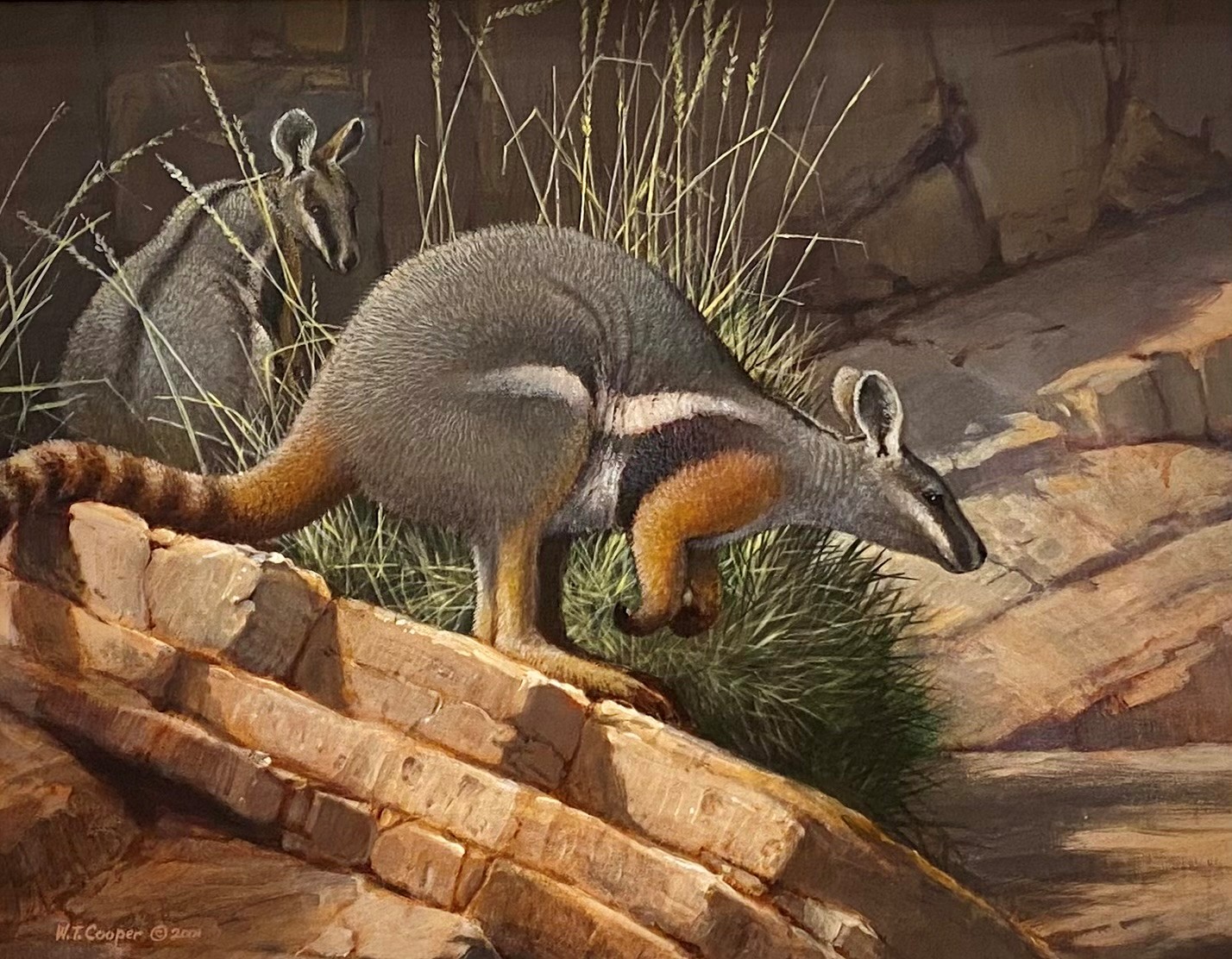
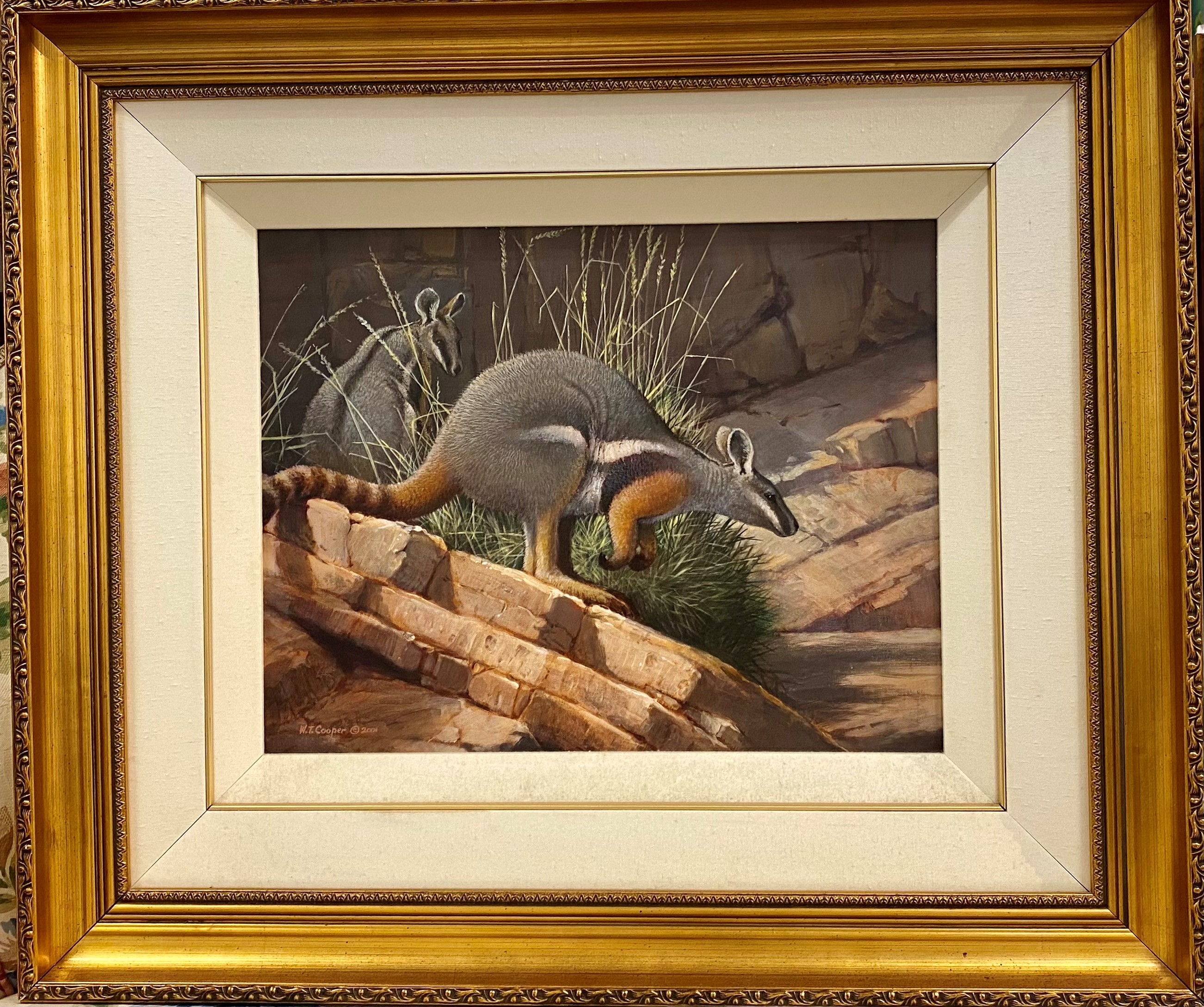
The yellow-footed rock wallaby is one of Australia’s most beautiful and agile marsupials. Found among the rugged rocky ranges of South Australia, western New South Wales, and central-western Queensland, this remarkable species is perfectly adapted to life on steep cliffs and boulder fields. Although highly resilient and well suited to its harsh environment, the yellow-footed rock wallaby is currently listed as Near Threatened, making ongoing conservation efforts essential for its survival.
Its striking appearance makes it one of Australia’s most distinctive native mammals. The wallaby has a soft fawn-grey coat with white underparts, while its forearms, hind legs, and feet are a vivid yellow to orange. Bold white stripes run along its cheeks and flanks, complemented by a dark stripe extending down the centre of its back. A long, ringed tail provides excellent balance when moving across rocky terrain. Adult wallabies typically weigh between 6 and 11 kilograms. They inhabit rocky escarpments, cliffs, gorges, and boulder fields throughout Australia’s semi-arid regions. These rugged landscapes provide ideal shelter from predators, access to reliable water sources, and an abundance of native grasses, shrubs, herbs, and other vegetation that form their diet.
Primarily nocturnal, these wallabies spend the heat of the day resting in cool rock crevices before emerging at dusk to feed. They are exceptional climbers and jumpers, capable of leaping up to four metres between rocks while effortlessly navigating steep cliff faces. Their textured foot pads provide excellent grip, while their long tail acts as a counterbalance, allowing them to move with remarkable speed and precision across uneven terrain. As herbivores, yellow-footed rock wallabies feed mainly on grasses, herbs, leaves, shrubs, and native forbs. During times of drought, they survive by eating fallen leaves and bark when fresh vegetation becomes scarce. When water is available, they can drink more than 10% of their body weight within just a few minutes, helping them remain hydrated in Australia’s harsh climate.
Bill Cooper AO is known throughout the world for his paintings; The Australian and New Guinean and Nigerian Governments have bought and displayed his original paintings produced for his earlier books. Sir David Attenborough has produced documentaries on his work. The Academy of Natural Sciences of Philadelphia gave him a rare accolade by presenting him with gold medal for distinction in natural history art. He was the first Australian to be given such an award. The academy does not invite competition for the medal and awards, it only periodically, after scanning the globe for someone “whose artistic endeavours have contributed to mankind”. Books have occupied most of Mr. Cooper’s working life for 30 years. He has published major works on “Birds of Paradise and Bower Birds”, “Parrots of the World”, “Australian Parrots”, and “Kingfishers”. These are equivalent to John Gould’s famous books. Bill Coopers paintings have set a new standard for excellence for scientific publications. His paintings are described as modern monuments to science and art. Bill passed away on 10th May 2015.